
A new study turns an old Chinese saying into a story about gut bacteria, tiny molecules, and two symptoms that surprisingly travel together
If you have ever bought a "no sugar added" drink, there is a good chance a small green-brown fruit from southern China made it taste sweet. Monk fruit, or luo han guo, is one of the most popular natural sweeteners in the world, and its sweetness is so intense that a tiny amount is enough. Long before it appeared on supermarket shelves, though, the same fruit sat in Chinese medicine cabinets, dried and steeped into a dark tea for dry throats, stubborn coughs and sluggish bowels.
That old recipe contains a quiet puzzle. Why would one fruit be used for both breathing and digestion, two jobs that seem to have nothing to do with each other? A team of pharmacologists at Shanghai Jiao Tong University decided to find out. Their study, published in 2026 in the journal Phytomedicine, does more than confirm that the fruit works in animals. It traces, step by step, how something swallowed into the stomach can end up calming inflammation in the lungs. The answer, it turns out, begins with the trillions of bacteria living in the gut.
Chinese medicine has a phrase for this: "the lung and the large intestine are an inside-outside pair." For centuries it was a way of saying that trouble in one organ tends to show up in the other. Modern biology has arrived at a similar idea from a completely different direction, and given it a name: the gut-lung axis.
The connection is not mystical. The gut and the lungs share a communication network made of blood, immune cells and chemical messengers. When gut bacteria break down fibre, they produce small fatty acids that enter the bloodstream and travel around the body, including to the lungs, where they help teach the immune system when to stay calm. Immune cells trained in the gut can also travel to the airways. So a disturbed gut can send a "danger" signal that ends up as inflammation in the chest, and inflammation in the lungs can leak back into the intestine. Think of it less like two separate rooms and more like two neighbours sharing a very thin wall.
Doctors have noticed the link for years. People with inflammatory bowel disease develop asthma and pneumonia more often than others. People who are regularly constipated show a higher risk of asthma. Patients with chronic obstructive lung disease frequently struggle with constipation too. And when breathing problems and gut problems occur together, the illness as a whole tends to be more severe.
Yet most laboratory research has looked at one condition at a time: an asthma model, or a constipation model, but rarely both. That is a bit like testing a bridge by only ever driving on one side of it. So the Shanghai team built something unusual: animals that had allergic asthma and functional constipation at the same time. It is closer to the messy reality of a real patient, and it let them ask a question that had not been properly asked before. Can one treatment really help both ends of the axis?
The team started with dried monk fruit supplied from Guangxi, the fruit's home region, and made a concentrated extract of its saponins, the family of naturally frothy compounds that carries most of the fruit's biological activity and includes the molecules responsible for its sweetness. Chemical analysis identified 41 related saponins in the mixture, with one called mogroside V making up nearly 40 percent of the total.
They then gave the extract by mouth to the asthmatic-and-constipated animals, comparing it with two benchmarks: Xuanbai Chengqi Decoction, a classic Chinese formula used for exactly this kind of combined lung-and-bowel problem, and purified mogroside V on its own. Afterwards they examined the lungs, the colon, the blood, the immune cells and, crucially, the gut bacteria. Nothing here was a quick glance. They measured airway thickness, mucus, stool water, gut hormones, the integrity of the intestinal lining, and dozens of immune signals, in both the lung tissue and the lymph nodes that serve the intestine.
A note on the labels in the figures. The images below come straight from the original paper, so they carry the shorthand scientists use. Control means healthy animals, AFC means animals with allergic asthma and functional constipation together, SFTS is the monk fruit total saponin extract (L and H are the low and high doses), MV is purified mogroside V on its own, and XBCQD is a classic Chinese formula used as a comparison treatment. Where you see 'ns' above a chart, it means 'not significant', the difference was too small to count. You do not need to memorise any of it: in each picture, simply compare the sick group with the treated group.
The untreated animals were in a sorry state. Their airways were thickened and crowded with inflammatory cells, their lungs were producing far too much mucus, and the allergic alarm signals in their lung tissue were sky-high. At the other end, their stools were small and dry, the protective mucus layer of the colon had thinned, and the hormones that keep the gut moving had dropped. In short, both ends of the axis were inflamed at once.
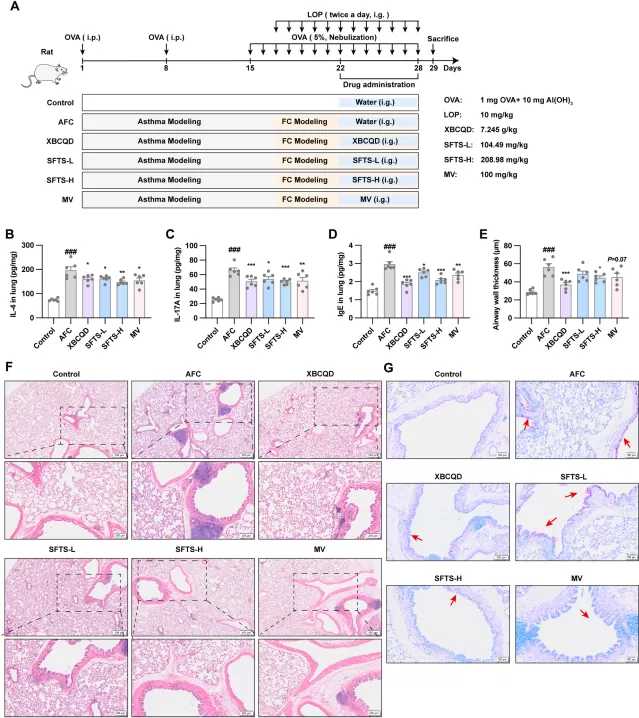
Figure 2 | The lungs, before and after. The pink slices at the bottom (panel F) are lung tissue under a microscope. In the untreated group (AFC), dark immune cells crowd the airways and the airway wall is thick; after the monk fruit saponin extract (SFTS-L and SFTS-H) the tissue looks close to the healthy control. The blue panels (G) stain mucus, which is overproduced in the sick animals and reduced after treatment. The bar charts above put numbers on the same story. Control = healthy animals; AFC = allergic asthma plus constipation; XBCQD = a classic Chinese formula used as a comparison; MV = purified mogroside V.
(Image: Fig. 2 from Pu et al., Phytomedicine 150 (2026) 157755)
After the saponin extract, both ends settled down. The airways opened up, the excess mucus faded and the allergic signals fell. The stools regained moisture, the colon's lining rebuilt itself, and the gut began moving again. Beneath these visible changes, the immune system had stopped overreacting. In an allergic response, one set of immune cells behaves like a stuck accelerator while the cells that normally apply the brake fall quiet. The extract restored that balance, in the lungs and in the gut's lymph nodes alike. Purified mogroside V helped too, but more narrowly: it calmed some signals, yet on measurements such as the thickness of the airway wall it produced no clear benefit at all.
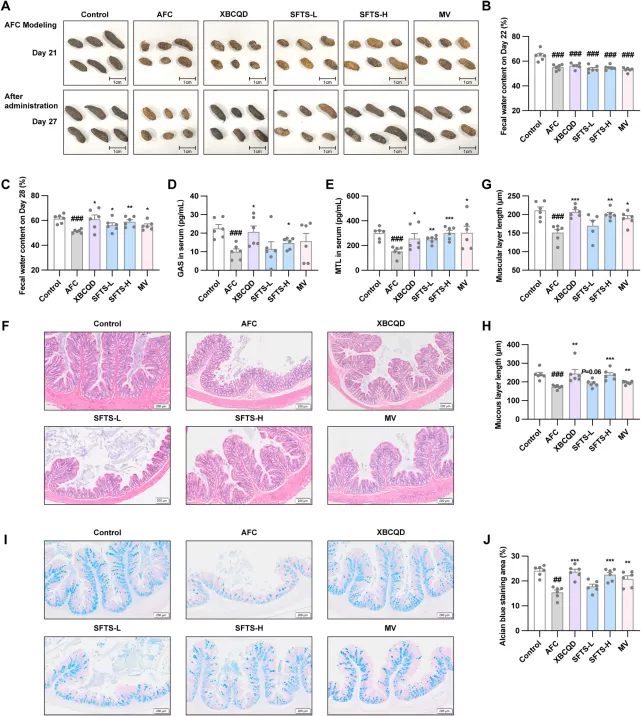
Figure 3 | The gut, before and after. The photographs at the top (A) are actual stool samples. Sick animals produce small, dry, fragmented pellets; after treatment the pellets are rounder and moister. The pink cross-sections (F) show the colon lining, which is damaged in the untreated group and rebuilt after the extract, while the blue panels (I) stain the protective mucus layer that thins in constipation and returns with treatment. It is the same fruit, the same animals, and the other end of the axis.
(Image: Fig. 3 from Pu et al., Phytomedicine 150 (2026) 157755)
Now for the most interesting part. The team suspected that the extract was not acting on the lungs directly, but by changing the community of microbes in the gut. In the sick animals, that community was badly out of balance, and the supply of those small fatty acids made from fibre had gone haywire. Treatment brought back several groups of helpful bacteria, including Lactobacillus, a familiar name from yoghurt labels, and returned the fatty acid levels towards normal. When the researchers looked at all their data together, the microbes and their products tracked closely with the improvements in the lungs.
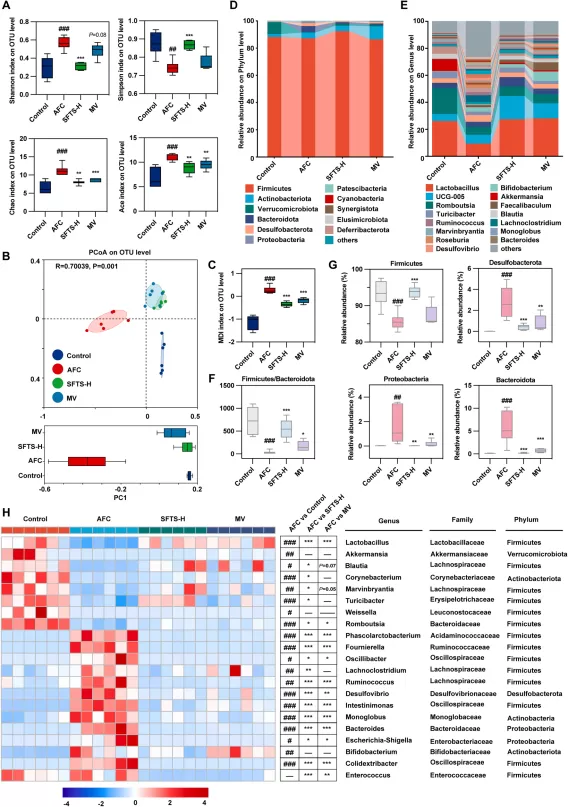
Figure 5 | A microbial community out of balance, then restored. Each coloured band in the stacked bars (D, E) represents a different group of gut bacteria. The sick animals (AFC) look strikingly different from the healthy controls; after the saponin extract (SFTS-H) the pattern moves back towards normal. The red-and-blue grid (H) lists the bacterial groups that changed most, with Lactobacillus and Blautia among those that came back.
(Image: Fig. 5 from Pu et al., Phytomedicine 150 (2026) 157755)
Correlation, however, is not proof. So they ran the experiment that makes this study genuinely convincing. They gave a separate group of animals a cocktail of antibiotics to clear out most of their gut bacteria, made those animals sick in the same way, and gave them the same extract. This time, almost nothing happened. The lung inflammation stayed, the constipation stayed, the immune imbalance stayed. It was as if the medicine had lost its messenger. Take away the microbes and the fruit can no longer deliver the message, which is a strong hint that the bacteria are not bystanders but the actual couriers. Curiously, even in these nearly germ-free animals the extract still encouraged a little Lactobacillus growth, which may explain the small residual benefit the team observed.
Take away the gut bacteria, and the fruit loses almost all of its power over the lungs. That single experiment is the clearest evidence in the paper.
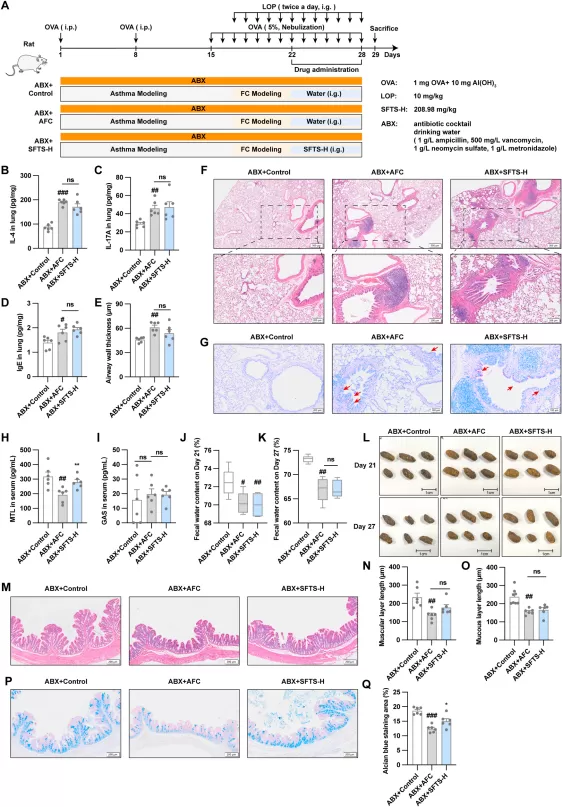
Figure 9 | The experiment that seals the argument. These animals had their gut bacteria cleared with antibiotics (ABX) before being made sick, and still received the extract. Look for the letters 'ns' above the bar charts: they mean 'not significant', in other words the treatment made no measurable difference. The lung slices (F, G) and the stool photographs (L) stay just as abnormal with or without the extract. Remove the microbes and the medicine loses its messenger.
(Image: Fig. 9 from Pu et al., Phytomedicine 150 (2026) 157755)
Inside the body, the researchers identified two control points. The first is a chain of proteins that behaves like a master inflammation switch: when the gut community falls out of balance, this chain flips on in both the lung and the colon and the immune system starts pumping out alarm signals. The extract turned it down. The second is a switch that helps cells manage energy and water, and switching it on seemed especially important for getting the bowel moving again.
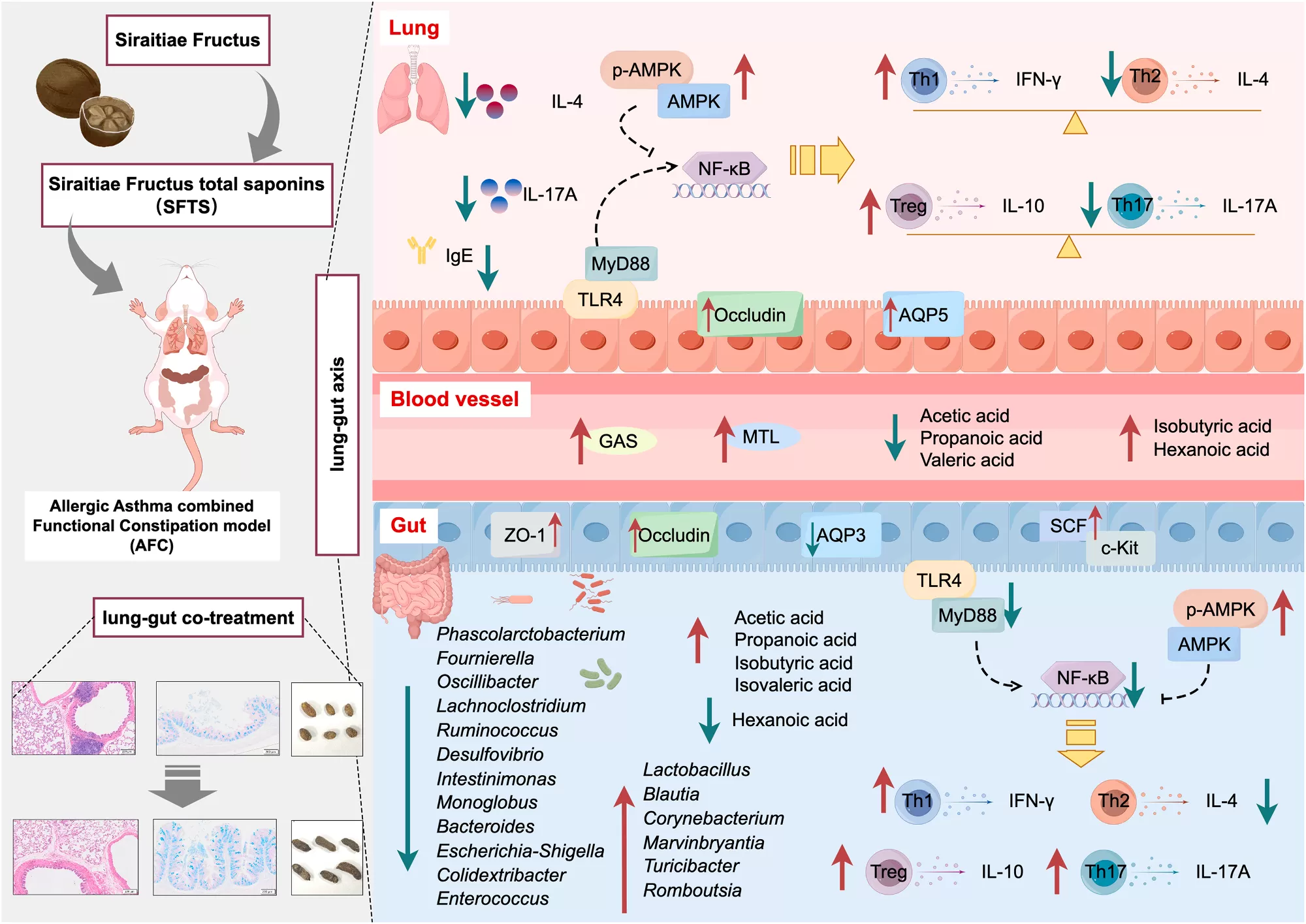
Figure 18 | The whole story in one picture, drawn by the authors. You do not need to read every label. Simply follow the layout: the fruit and the extract are on the left, the lung is at the top, a blood vessel runs through the middle, and the gut with its bacteria is at the bottom. The arrows are messages travelling between them. Red and blue arrows mark signals that rose or fell after treatment, and the small microscope images at lower left are the lung and colon tissue shown in the figures above. Every label and arrow comes from the paper itself.
(Image: Fig. 18 from Pu et al., Phytomedicine 150 (2026) 157755)
Again, the team did not simply describe these switches, they broke them on purpose. In mice bred without a key gene in the inflammation chain, the extract lost its ability to calm the lungs and the gut. In mice given a drug that blocks the energy-and-water switch, the lung benefits partly survived, but the constipation relief all but disappeared: the stool stayed dry, the gut did not speed up and the colon did not recover. Two elegant failures, each telling a different story. The inflammation switch is the shared backbone of the whole effect; the energy switch is mainly the gut's own lever. This is what good science looks like in practice: you do not just watch a key open a door, you check that it stops working when you change the lock.
Figure 14 | Switching off one switch removes the gut benefit. The stool photographs at the top (A) tell the story at a glance: the extract alone (SFTS-H) restores plump, moist pellets, but when a drug that blocks the energy-and-water switch is added (SFTS-H+CC), the pellets stay small and dry. The colon cross-sections below (G, J) and the many 'ns' labels confirm that blocking this switch largely cancels the constipation relief, while part of the lung effect survives. CC = Compound C, the AMPK inhibitor used in the experiment.
(Image: Fig. 14 from Pu et al., Phytomedicine 150 (2026) 157755)
There is a pleasing lesson here for anyone who assumes a plant can be reduced to one "active ingredient." Mogroside V is the fruit's celebrity compound, the one industry extracts for sweetener and the one that makes up the largest single share of the saponin mixture. Yet on its own it consistently underperformed the full extract. The authors' explanation is teamwork: other saponins in the mixture, including a close relative called 11-O-mogroside V, appear to help one another along, hitting several targets at once rather than a single one. Herbal medicine often works this way, as a choir rather than a soloist, and this study puts careful measurements behind that intuition.
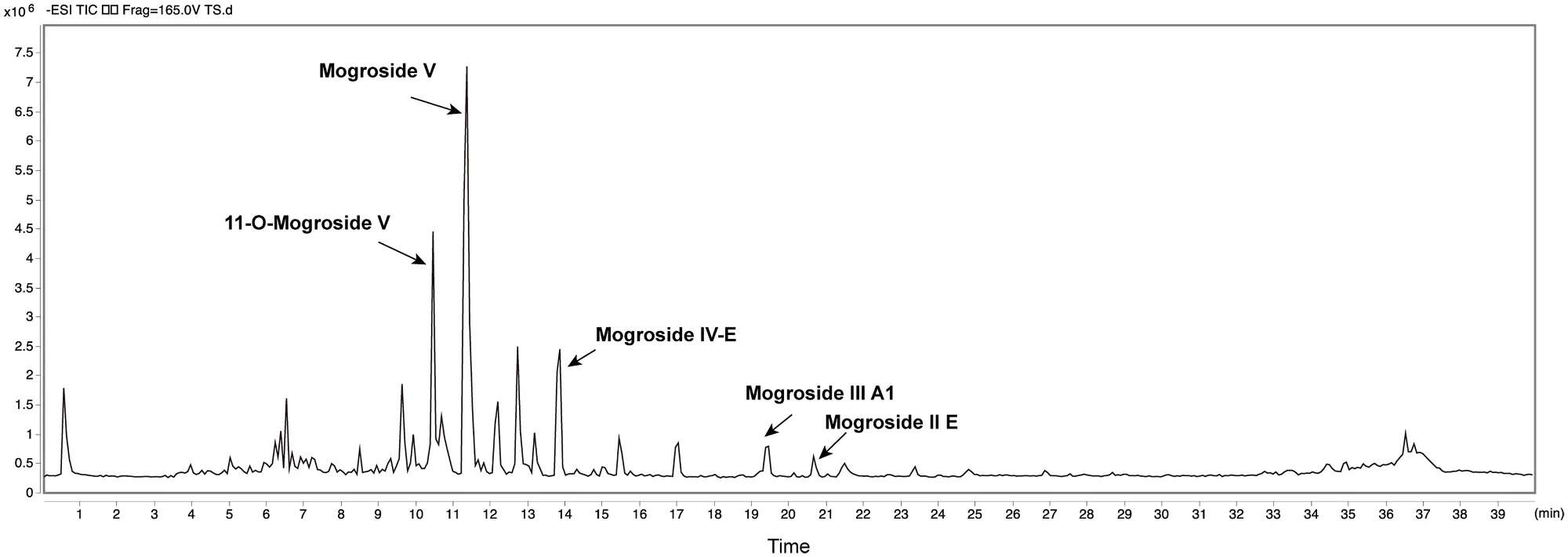
Figure 1 | The chemical fingerprint of the extract. Every peak is a different molecule in the monk fruit saponin mixture. The two tallest peaks are mogroside V and its close relative 11-O-mogroside V, but the smaller peaks around them are dozens of other saponins, 41 in total. This is what 'a team rather than a soloist' looks like in the laboratory.
(Image: Fig. 1 from Pu et al., Phytomedicine 150 (2026) 157755)
It is worth being quite clear about what this study does not say. All of the work was done in rats and mice, not in people. The animals received a purified, concentrated extract at carefully calculated doses derived from the traditional 15-gram daily dose of the dried fruit, not a casual cup of monk fruit tea, and certainly not the pinch of sweetener in a soft drink. No one has yet shown that drinking monk fruit tea relieves an asthma attack or treats constipation in humans. The authors themselves list what is still missing: direct experiments that transplant gut bacteria to prove the chain of cause and effect, a clearer picture of which fatty acids matter most, and the still-unanswered question of whether the fruit helps the gut first or the lungs first. If you live with asthma, this is a fascinating piece of biology, not a reason to change your medication.
What makes this study worth reading is not the promise of a new home remedy. It is the way an old, slightly baffling piece of traditional knowledge, that a fruit for the lungs is also a fruit for the bowels, turns out to describe something real. Your lungs and your gut are in constant conversation, your gut bacteria are among the ones carrying the messages, and a humble dried fruit can, at least in the laboratory, change the tone of that conversation. An ancient clinical observation, finally translated into the language of microbes, molecules and switches. Sometimes the most satisfying science is not a surprise, but an explanation.
THE PAPER
Pu Z, Peng Y, Chen X, Ma Y, Liu Y, Li X. "Heat-dissipating, lung-moistening, and constipation-relieving" effects of Siraitiae Fructus total saponins regulated through gut-lung axis. Phytomedicine 150 (2026): 157755. School of Pharmacy, Shanghai Jiao Tong University. doi: 10.1016/j.phymed.2025.157755







 EN
 EN
 CN
 ES
 PT
 SV
 DE
 TR
 FR
 AR
 BG
 HR
 CS
 DA
 NL
 FI
 EL
 HI
 IT
 JA
 KO
 NO
 PL
 RO
 RU
 CA
 TL
 IW
 ID
 LV
 LT
 SR
 SK
 SL
 UK
 VI
 SQ
 ET
 GL
 HU
 MT
 TH
 FA
 AF
 MS
 GA
 BE
 UZ
